These are the stories that make elite power feel natural, deserved, or even benevolent. They don’t just justify inequality—they invite participation in it, often without awareness.
The Meritocracy Myth
- The belief that success is earned through talent and hard work alone.
- Masks inherited privilege, structural barriers, and systemic bias.
- Turns inequality into a moral judgment: “If you’re poor, you didn’t try hard enough.”
We’re told that success is earned through talent and hard work. This story is seductive—it flatters the successful and shames the struggling. But it’s a myth that masks inherited privilege, structural barriers, and systemic bias.
Students from wealthy families inherit networks, tutors, and safety nets.

Marginalized communities face gatekeeping in education, hiring, and housing.
Neurodivergent, disabled, and caregiving individuals are excluded from “grind” culture.
Meritocracy turns inequality into moral judgment: “If you’re poor, you didn’t try hard enough.” It erases the emotional labor of surviving systems that were never built for you. It makes resistance feel like laziness, and rest feel like failure.
In truth, meritocracy is a ritual of consent—inviting us to participate in our own erasure.
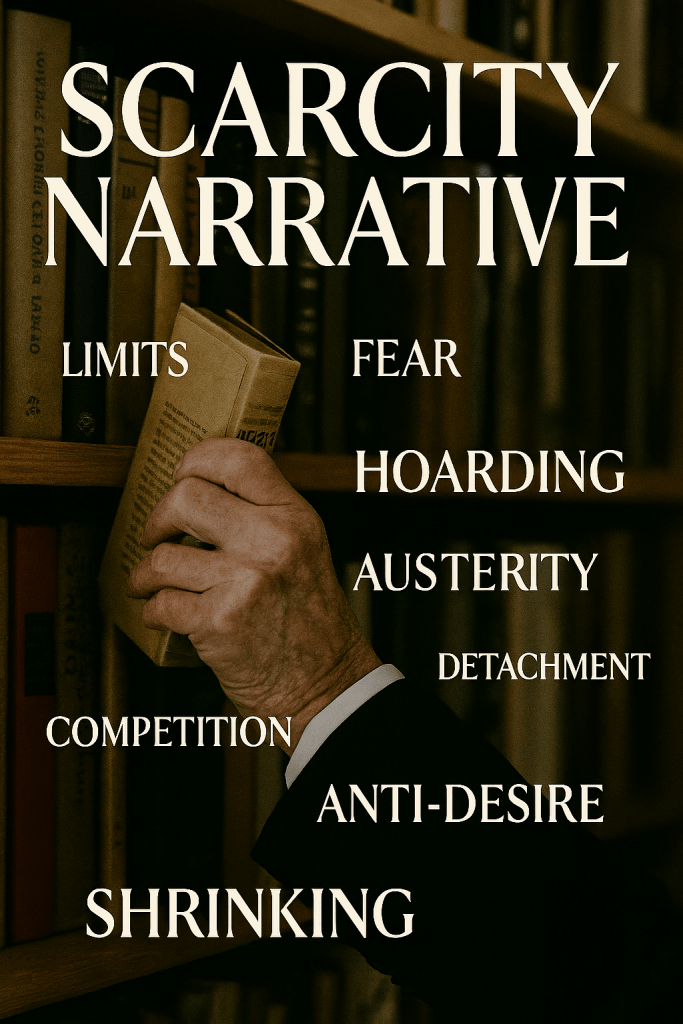
The Scarcity Narrative
- Frames resources as limited, competition as necessary, and austerity as responsible.
- Justifies hoarding, privatization, and exclusion.
- Prevents collective imagination of abundance, mutual aid, or reparative economics.
Scarcity is framed as natural: “There’s not enough to go around.” But scarcity is engineered—through hoarding, privatization, and extractive design.
- There’s enough food to feed 10 billion people.
- There are more empty homes than unhoused people.
- Solar energy could power the planet thousands of times over.
Yet we’re told to compete, to settle, to shrink. Scarcity justifies austerity, exclusion, and emotional detachment. It prevents us from imagining abundance, mutual aid, or reparative economics.
Scarcity is not a condition—it’s a spell. And breaking it begins with naming it.
The Nationalism & Identity Myth
- Uses flags, borders, and cultural pride to divide and distract.
- Frames outsiders as threats, insiders as deserving.
- Redirects anger away from elites and toward marginalized groups.
Nationalism uses flags, borders, and cultural pride to divide and distract. It tells us who belongs and who threatens. It redirects anger away from elites and toward the marginalized.
- Immigrants are framed as “taking” jobs, while billionaires offshore wealth.
- Queer and trans people are scapegoated, while institutions erase care.
- Racialized communities are criminalized, while elite violence is legalized.
This myth ritualizes tribal loyalty and emotional containment. It makes solidarity feel dangerous. It makes grief for others feel unpatriotic.
Nationalism is not about love—it’s about control. And movements must reclaim belonging as care, not border.
The Technocratic Neutrality Myth
- Claims that algorithms, data, and “experts” are objective.
- Hides bias behind complexity and jargon.
- Delegitimizes lived experience and grassroots wisdom.
We’re told that algorithms, data, and “experts” are objective. But technocracy hides bias behind complexity. It delegitimizes lived experience and grassroots wisdom.
- Predictive policing targets Black and brown communities.
- Algorithmic admissions and hiring replicate elite bias.
- “Evidence-based” policy often excludes Indigenous, disabled, and poor voices.
Technocracy makes injustice feel rational. It makes harm feel inevitable. It turns emotional truth into “anecdote,” and community wisdom into “noise.”
Neutrality is not justice. And movements must reclaim data as story, algorithm as ritual, and expertise as shared.
These myths do the labor of consent by shaping what feels possible, permissible, and personal. They’re embedded in media, education, policy, and even self-help culture. And they’re often internalized—making resistance feel like betrayal or failure.
Labor of consent is the emotional and symbolic work required to make systems of harm feel legitimate, inevitable, or desirable. It’s not just propaganda—it’s ritualized conditioning.
- It shapes what feels possible (e.g., “You can succeed if you work hard”).
- It shapes what feels permissible (e.g., “It’s okay to hoard wealth if you earned it”).
- It shapes what feels personal (e.g., “If you’re struggling, it’s your fault”).
Consent is not just given—it’s engineered through myth, media, and emotional design.
Make a one-time donation
Make a monthly donation
Make a yearly donation
Choose an amount
Or enter a custom amount
Your contribution is appreciated.
Your contribution is appreciated.
Your contribution is appreciated.
DonateDonate monthlyDonate yearly- How do laws, algorithms, and data infrastructures encode inequality?
- How do financial flows reinforce elite influence?
- Structural Definition: Usefulness as Economic Utility
- Why do we “spell”?
- Myths, narratives and the labor of consent
- How the Elite Maintain Control
- 10 Elite Patterns Worth Naming
- The Myth of Scarcity: 10 Interesting Facts
 The Non-Traditional Student
Leave a comment